Barry Li | Climate Reporting & Assurance

Insights on climate reporting, carbon markets, and sustainability assurance.

  • In brief: The Australian Carbon Credit Unit (ACCU) Scheme lets registered projects earn tradeable carbon credits by avoiding, reducing or removing emissions (e.g., land sector, waste, industrial methods). It’s an operational crediting regime under the Carbon Credits (Carbon Farming Initiative) Act 2011, administered by the Clean Energy Regulator (CER). It’s separate from financial reporting standards like AASB S2/IFRS S2. (DCCEEW)

    Who it really applies to:

    • Project proponents who register a method under the ACCU Scheme to generate credits and sell/retire them.
    • Safeguard Mechanism facilities that may use ACCUs to offset emissions above baselines. (Clean Energy Regulator)

    Who it usually doesn’t apply to:

    • Most general private-sector businesses coming into scope for AASB S2 climate disclosure. They typically won’t need to interact with ACCUs unless they choose to voluntarily offset, or are captured by the Safeguard. (Different laws, different purposes.)

    Assurance/audit:

    • Scheme audits are not financial statement audits and must be performed by CER-registered greenhouse & energy auditors (audit team leader must be on the Register). Find an auditor here: CER Register of Greenhouse & Energy Auditors. (Clean Energy Regulator)

    Tensions & issues (very brief)

    • Quality differentiation & premiums: prices can vary by method (e.g., HIR vs “generic”), and buyers often pay more for units perceived as higher-integrity or with co-benefits. (Clean Energy Regulator)
    • Evolving market design: new trading infrastructure and liquidity have grown, with ongoing scrutiny of methods and governance. (Xpansiv)

    Should firms disclose net or also gross emissions?

    For transparency, firms that use offsets should still disclose gross emissions (what you actually emitted) and any net figure after ACCU use. Gross shows real operational performance; net shows your offsetting strategy. (This is my personal view, aligned with emerging investor expectations—not advice.)


    ACCU price highlights (selected points)

    (Prices vary by method; figures below are for “generic” ACCUs unless noted.)

    Note: ACCUs are not homogeneous. Some methods/attributes trade at premiums. Always check the unit type you are discussing or buying. (Clean Energy Regulator)


    Why this matters (watch this space)

    Most businesses under AASB S2 won’t need ACCUs for compliance. However, policy settings can change (e.g., Safeguard thresholds, coverage). Better climate disclosures may give government more visibility over who could be brought into compliance markets in future. That’s my personal opinion only—not policy or advice.


    Official sources


    Disclaimer: This post is general information only and not financial advice. If you need to buy or retire ACCUs, seek advice from a qualified professional.

  • Australia already has fairly established regulatory regimes under the National Greenhouse and Energy Reporting (NGER) scheme and the Safeguard Mechanism. These aren’t new, they’re mature, and they operate under the Clean Energy Regulator (CER). They differ in purpose and scope from IFRS S2 / climate disclosure rules — but they matter, especially if the thresholds shift.


    What are NGER & the Safeguard Mechanism?

    • NGER (National Greenhouse and Energy Reporting Scheme) is a mandatory national framework requiring certain companies (or corporate groups) to report their greenhouse gas emissions, energy production, and energy consumption. (Clean Energy Regulator)
    • Safeguard Mechanism builds on NGER. It imposes emissions baselines on high-emitting facilities. If a facility emits more than its baseline, it must manage or offset the excess emissions (for example, by surrendering carbon credits). (Clean Energy Regulator)
    • All Safeguard facilities must also report under NGER (so the Safeguard doesn’t require a totally new reporting regime) (Clean Energy Regulator)

    What differentiates them from climate disclosure standards like IFRS S2 is that they are operations-based, enforcement mechanisms with compliance obligations, not just reporting guidelines.


    Key thresholds & who is in / out

    SchemeThreshold / triggerWho needs to worryNotes / caveats
    NGER facility threshold25,000 t CO₂-e (Scope 1 + 2) or 100 terajoules of energy production/consumption (facility level) (Clean Energy Regulator)Firms whose facilities individually exceed these levels must reportIf your facility is below, you may not need to report now.
    NGER corporate group threshold50,000 t CO₂-e or 200 TJ energy (group level) (Clean Energy Regulator)Corporate groups whose aggregated operations cross this limitMany medium firms stay below these for now.
    Safeguard threshold (responsible emitter)100,000 t CO₂-e (covered emissions) per financial year (Clean Energy Regulator)Facilities that exceed this level are “safe-guarded”These facilities must keep emissions below baseline or manage excess.

    So if your business currently operates under these thresholds, you may not have direct compliance obligations — but it’s wise to monitor for changes in policy.


    Audit, registration & oversight

    • Under NGER, audits must be conducted by CER-registered auditors. (Clean Energy Regulator)
    • The CER maintains a Register of Greenhouse & Energy Auditors (publicly accessible). (Clean Energy Regulator)
    • For Safeguard enforcement and some specialized determinations (like emissions intensity determinations or baseline adjustments), audit assurance is required. (Clean Energy Regulator)
    • Note: the audit team leader must be a registered auditor. (Clean Energy Regulator)

    Why this matters (and what to watch)

    • Though many private firms may not now cross the thresholds, policy change is possible. Governments may lower thresholds or broaden coverage, effectively turning distributional “carbon liability” onto more players.
    • The rollout of climate disclosure (like through AASB S2) gives regulators more information about emissions and business models — that data might inform decisions to expand NGER / Safeguard coverage.
    • If you’re preparing now (data systems, baseline estimation, internal controls), you’re better placed to respond if thresholds shift.
    • Risks of non-compliance are real. Entities with registered facilities must manage excess emissions, surrender credits, or face penalties.

    Note: This article reflects my personal perspective, based on current public sources. Policies, thresholds, or rules may evolve. Please check back for updates.


    Useful sources & further reading


  • In plain terms: IFRS S2 (Climate-related Disclosures) is an international standard that tells organisations how they should report the financial risks and opportunities caused by climate change (e.g. how severe weather, carbon regulation, or transition risks might impact cash flows, costs, assets). In Australia, this is being adopted as AASB S2, becoming a mandatory requirement for many private sector businesses.


    What is AASB S2 (Australia’s version)

    • AASB S2 is based on IFRS S2, but tailored for Australia’s legal and institutional context. (AASB)
    • It focuses solely on climate-related disclosures (unlike a broader sustainability standard). (PwC)
    • Key disclosure pillars:
      1. Governance – who is responsible, oversight, controls
      2. Strategy – how climate risks/opportunities affect your business model, value chain, transition plans
      3. Risk Management – how you identify, assess, manage climate risks
      4. Metrics & Targets – emissions (Scope 1, 2, and eventually Scope 3), targets, progress, scenario analysis (PwC)
    • Australian tweaks:
      • Some paragraphs from IFRS S1 (general sustainability disclosures) are integrated into Appendix D to make AASB S2 standalone. (standards.aasb.gov.au)
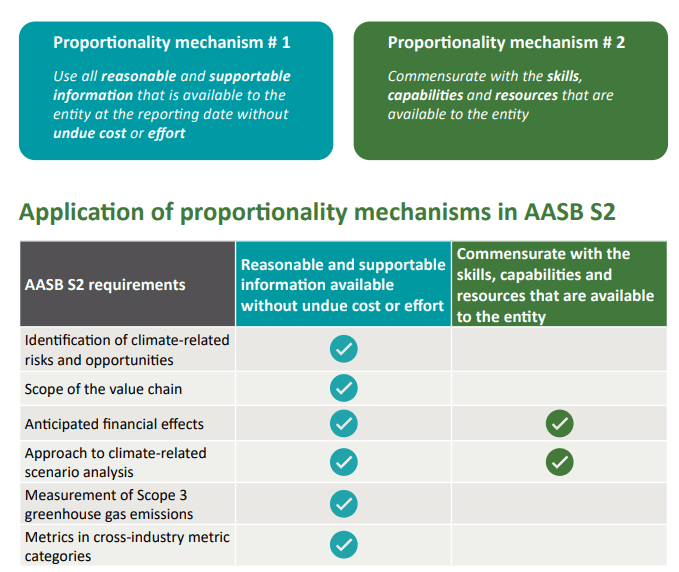
      • Entities don’t have to disclose industry-based metrics as IFRS S2 might require. (PwC)

    Who must comply & when

    • The legal requirement comes through amendments to the Corporations Act 2001 under Treasury’s new climate disclosure regime. (KPMG)
    • Reporting is phased by entity “groups”:
      • Group 1: first reporting period beginning on or after 1 January 2025 (AASB)
      • Group 2: periods starting 1 July 2026
      • Group 3: periods starting 1 July 2027 (AASB)
    • As an example, companies with a 30 June year end in Group 1 must report climate disclosures in the 2025–26 financial year (i.e. for the full year from 1 July 2025 to 30 June 2026). (Anthesis)

    What this means for private sector businesses

    • Businesses in scope will need to build systems to track Scope 1 & 2 emissions, and over time Scope 3 (indirect) emissions.
    • They’ll need to adopt scenario analysis, set climate-related targets, and disclose assumptions and uncertainties.
    • Governance change: senior management and boards will need to oversee climate strategy and ensure accountability.
    • Assurance (external audit) will be phased in over time (some disclosures may require limited or reasonable assurance in future). (KPMG)
    • There is liability risk: misleading or false statements in climate disclosures could attract penalties under Corporations Act rules (similar to financial reporting rules). (KPMG)
    • Private sector entities not yet covered (smaller firms) should begin preparing now — build capacity, do gap assessments, plan strategy.

    High-level timeline & caveats

    PhaseEffective dateWhat to do / notes
    Legislation passed & standards issued20 September 2024 (AASB)AASB published the final S2, and the legal basis was reinforced by amendments to the Corporations Act. (PwC)
    First reporting for Group 1From financial periods beginning 1 January 2025 (AASB)Entities in Group 1 must prepare their first climate disclosures in the first full eligible financial year.
    Later phases1 July 2026, 1 July 2027 for Groups 2 & 3 (AASB)The rollout allows smaller or less emissions-intensive entities time to build capability.

    ⚠ This timeline is based on current drafts and announcements — subject to legislative or regulatory change. Return to this site for updates and commentary as rules evolve.


    What to read / official sources

    • The AASB’s official text: AASB S2 Climate-related Disclosures (Sept 2024) (standards.aasb.gov.au)
    • AASB’s FAQ & Knowledge Hub on S2 (AASB)
    • KPMG overview of Australia’s legislative framework and mandatory climate disclosure regime (KPMG)
    • EY illustrative examples & disclosure checklist for AASB S2 (ey.com)

  • Hello, and welcome!

    This site is a space where I will share reflections, updates, and resources from my research and professional practice in climate reporting, carbon markets, and sustainability assurance. As both a PhD candidate at the University of Newcastle and an auditing practitioner with over a decade of experience in the public sector, I am interested in how assurance practices are evolving and how complex topics like carbon accounting are made auditable.

    My plan is to post short “briefings” on developments in standards, regulations, and practice, along with insights from my research journey. These posts will aim to bridge academic thinking with practical challenges in audit and assurance.

    Thank you for visiting, and I hope you will find these updates useful and thought-provoking. Please feel free to connect with me on LinkedIn if you would like to continue the conversation.