Barry Li | Climate Reporting & Assurance

Insights on climate reporting, carbon markets, and sustainability assurance.

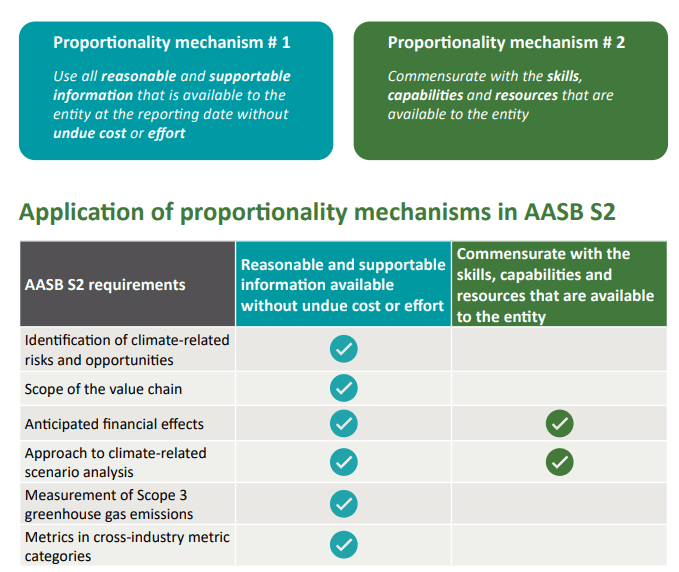
  • In September 2025, the AASB published a guidance note titled “Proportionality Mechanisms in AASB S2” (9 September), clarifying how entities should apply judgement so that climate disclosures are scaled sensibly to size, complexity, and capacity.
    This move helps signal that while the standard is mandatory in scope, not every disclosure has to be equally elaborate.


    What the proportionality guidance says (in practice)

    • The mechanisms allow entities to use reasonable and supportable information available at the reporting date — without undue cost or effort. (ESG Broadcast)
    • Entities can adopt more scaled-back approaches in areas like scenario analysis, methodologies, or quantification when full technical work is impracticable given their resources. (ESG Broadcast)
    • Importantly, proportionality does not remove disclosure obligations. Entities must still meet all core objectives of AASB S2, but can manage how deeply or quantitatively to go in each section. (ESG Broadcast)
    • The guidance identifies which parts of the standard are more amenable to proportional judgment (governance, risk identification, value-chain scoping, financial effect estimates, scenario work). (ESG Broadcast)

    This clarification is a strong signal: the Board expects flexibility, but wants clear documentation of judgments, method limitations, and rationale.


    Why this matters (especially for smaller or mid-tier entities)

    • Many organisations fear that compliance with S2 will require heavy modeling, climate science expertise, or third-party consultants. The proportionality guidance offers breathing room.
    • It helps bridge a capability gap: firms with limited data, technical staff, or budget can still comply meaningfully without being penalised for not doing everything at “Big 4 level.”
    • The guidance supports the phased rollout to Group 2 and 3 reporters in 2026–27 by setting expectations of scalability rather than uniformity.
    • However, the flipside: those who adopt minimal disclosures too early risk being judged harshly by auditors, regulators, or stakeholders if their rationale is opaque.

    What preparers and auditors should do now

    • Map out which portions of S2 you will scale back (e.g. limited scenario modelling, qualitative risk impact descriptions) and document why you adopted those choices.
    • Use the proportionality guidance to defend judgment calls if auditors query your methodological shortcuts.
    • Don’t over-simplify: even scaled disclosures must still respond to all four pillars (governance, strategy, risk management, metrics/targets).
    • Prepare for future benchmarking: as more entities disclose, the bar for minimal acceptable practice will evolve, so build your disclosure capability progressively.
    • Audit teams should treat proportional disclosures as red-flag areas — check whether the judgment is defensible, transparent, and consistent with your entity’s context.

    Closing (my take)

    This proportionality guidance is a smart, necessary balancing act. It signals that AASB expects inclusivity — letting smaller or less sophisticated entities comply in ways that match their capacity — while preserving the core disclosure goals.

    However, not all practitioners will interpret “proportionate” the same way. The real test will lie in assurance practice, regulator reviews, and peer benchmarking. In my upcoming research, I’ll be watching how proportionality is implemented, challenged, and rationalised — especially where scaled approaches verge on minimalism.

    📘 Source: AASB Proportionality Mechanisms in AASB S2 (9 Sept 2025) (AASB)
    Additional contextual reporting framework: KPMG’s summary of Australia’s sustainability reporting regime (KPMG)

  • September was a busy month for Australia’s evolving climate reporting landscape. With the first mandatory disclosures under AASB S2 Climate-related Financial Disclosures due from 1 January 2025, regulators and standard-setters spent the month issuing guidance, educational materials and reminders to help companies and auditors get ready.

    Below is a concise recap of what changed or was clarified in September 2025—and what it means for reporting entities as the regime moves from policy to practice.


    1. AASB guidance on proportionality: scaling S2 for smaller entities

    On 9 September 2025, the Australian Accounting Standards Board (AASB) released guidance explaining how the “proportionality mechanism” in AASB S2 should work.
    The document outlines how entities can apply judgement to make their disclosures commensurate with size, complexity and climate exposure.

    The message is clear: the standard applies to everyone in scope, but not every disclosure needs to look the same. Smaller or less complex entities may use simplified scenario analysis or more qualitative data—so long as they still meet S2’s disclosure objectives.

    For practitioners, this guidance provides welcome clarity. It reinforces that “one size fits all” reporting was never the intent. Instead, scalability is built in, supporting the phased rollout for Group 2 and Group 3 reporters in 2026–27.

    📘 Source: AASB Proportionality Mechanism in AASB S2 (9 Sept 2025).


    2. Educational material on greenhouse gas (GHG) disclosures

    Earlier in the month, the AASB issued educational guidance on GHG emissions disclosure under S2 (2 September 2025).
    This resource supports preparers facing the technical challenge of measuring and reporting emissions consistently with S2 and the Greenhouse Gas Protocol.

    Key themes include:

    • Clarification of Scope 1, 2 and 3 boundaries (Scope 3 required from year two).
    • Emphasis on credible measurement methods and estimation techniques where data gaps exist.
    • Alignment between NGER data (for entities already reporting under the National Greenhouse and Energy Reporting Act) and the numbers disclosed in the financial report.
    • Encouragement to reference industry-based metrics (e.g. SASB or ISSB guidance) where relevant.

    The AASB also reiterated the transition relief on Scope 3 emissions: companies must describe their approach in year one but only disclose figures in year two.
    For auditors, this educational material is equally valuable—it clarifies what constitutes acceptable methodology and estimation uncertainty for assurance planning.

    📘 Source: AASB Educational Material on GHG Disclosures (2 Sept 2025).


    3. Implementation reminders, liability relief and director attestations

    Reinforcing the 2025 start date

    By September, Group 1 entities (large listed and financial sector companies) were entering final preparation mode.
    ASIC publicly reiterated that it expects “full, true and fair” climate disclosures aligned with AASB S2—and warned against selective reporting where risks appear in investor presentations but not in statutory reports.
    No new regulatory guide was issued, but ASIC’s long-standing RG 247 is effectively superseded by S2.

    “Modified liability” now in force

    A major September talking point was the temporary safe harbour protecting companies and directors from private litigation over forward-looking climate information—such as Scope 3 estimates, scenario analysis or transition plans—provided statements are made in good faith.
    The shield runs until 31 December 2027, though ASIC retains enforcement powers. The aim is to encourage frank, early disclosure while the market gains experience.

    Director declarations

    For the first three years, boards need only declare that they have “taken reasonable steps to ensure compliance” rather than that the Sustainability Report gives a “true and fair view.”
    This lighter attestation acknowledges that climate reporting is new territory while still demanding documented governance oversight.

    📘 Sources: Treasury Laws Amendment (Climate-related Financial Disclosures) Act 2024, ASIC climate reporting resources.


    4. Progress on assurance standards

    While no new assurance standard was finalised in September, the AUASB continued work on ASSA 5010, complementing ASSA 5000 (already approved earlier in 2025).
    Audit firms are now developing methodologies for limited assurance on climate disclosures for FY 2025 reports.

    Across the profession, pilot engagements and training programs ramped up—particularly within public-sector audit offices and major accounting networks. Even where assurance is not mandatory this year, many entities are seeking voluntary reviews to enhance credibility ahead of investor scrutiny.

    📘 Source: AUASB Sustainability Assurance Developments.


    5. Sector-specific observations

    No new sector exemptions or amendments were released, but regulators used September to reinforce expectations:

    • Financial institutions should be leaders in Scope 3 “financed emissions” reporting and scenario analysis for credit and investment portfolios. APRA’s Climate Vulnerability Assessment complements S2 objectives.
    • Energy and resources entities must integrate NGER emissions and TCFD-style scenario work directly into financial statements. ASIC has signalled it will look for consistency between climate disclosures and asset valuations.
    • Manufacturing and industrials should pay attention to proportionality guidance—qualitative disclosures may be acceptable initially, but planning for quantitative data is essential.
    • Real estate and agriculture are expected to highlight exposure to physical climate risks (e.g. floods, heat, drought) in line with S2’s risk-management pillar.

    Practical next steps for accountants and auditors

    1. Finalise readiness for FY 2025 reports.
    Ensure draft Sustainability Reports align with AASB S2’s structure—governance, strategy, risk management, and metrics/targets. Use the AASB Knowledge Hub as a checklist.

    2. Apply proportionality wisely.
    Smaller entities can scale disclosures but should still cover every major requirement qualitatively. Document the rationale for lighter treatment to show compliance intent.

    3. Strengthen board engagement.
    Directors must demonstrate those “reasonable steps.” Keep minutes, training records and climate discussions well documented for audit evidence.

    4. Prepare for assurance—even if limited.
    Gather calculation workbooks, emission factors, scenario models and control documentation early. These will support both internal review and external assurance under ASSA 5000.

    5. Monitor for further updates.
    Expect more FAQs and examples from Treasury, ASIC, and the professional bodies as Group 1 entities begin publishing.


    The bottom line

    By the end of September 2025, the climate-reporting framework in Australia had moved firmly from rule-making to implementation.
    The AASB provided practical tools, the AUASB advanced assurance infrastructure, and regulators made clear that high-quality disclosure—not mere compliance—will be the expectation.

    For preparers and auditors, this is the last stretch before go-live. Those who embrace the AASB’s September guidance on proportionality, emissions measurement and director accountability will be best positioned to produce credible, decision-useful climate information in 2025 and beyond.


    Further reading


  • One recent paper that caught my attention is “Making things (that don’t exist) count: a study of Scope 4 emissions accounting claims” by Anna Young-Ferris, Arunima Malik, Victoria Calderbank, and Jubin Jacob-John, published in Accounting, Auditing & Accountability Journal (AAAJ).
    Read the abstract here.

    The paper examines so-called “Scope 4” emissions—avoided emissions resulting from energy efficiency initiatives or other actions that reduce emissions relative to a counterfactual. These claims are not part of the established Scopes 1, 2, and 3 framework, yet are increasingly referenced by firms and market actors.

    What I found especially interesting:

    • Scope 4 overlaps with some methodologies in the ACCU Scheme—such as avoided deforestation and energy efficiency projects.
    • The paper frames its analysis around legitimacy, noting how Scope 4 claims borrow the appearance of being part of the accepted emissions framework. Yet, it doesn’t explicitly invoke legitimacy theory. This shows how legitimacy is being performed through accounting even when not theorised directly.

    For my own work, this is a useful signal. I plan to explore how auditing contributes to the legitimisation of the ACCU scheme. This paper’s treatment of Scope 4 strengthens the case that audit plays a constitutive role in making contested things—such as offset credits—appear legitimate. It also reminds me to refine how I frame legitimacy in relation to assurance, market devices, and audit logics.

    The authors conclude with caution: Scope 4 claims risk distracting attention from the critical task of reducing absolute emissions. This resonates with wider debates about offsetting and greenwashing.

    In short: this is a sharp, thought-provoking study that opens space for further discussion of audit-made legitimacy in carbon markets.


  • Large firms often dominate climate assurance conversations, but mid-tier accounting firms and specialist consultancies are quietly building important capacity—and may offer more accessible options for many businesses.


    What mid-tier / boutique players are doing

    • Grant Thornton Australia offers ESG, sustainability and climate reporting assurance and advisory services, positioning themselves as a bridge between large firms and smaller clients. (Grant Thornton Australia)
    • Perspektiv, a boutique sustainability consultancy, provides services from materiality assessments and reporting through to verification and assurance. (Perspektiv Australia)
    • FTI Consulting Australia emphasizes ESG strategy, reporting, and assurance as part of its advisory portfolio. (fticonsulting.com)
    • Texfora helps smaller clients with carbon & sustainability consulting, regulatory compliance, and reporting. (Texfora Australia)
    • Cress Consulting specialises in sustainability strategy, carbon accounting, and reporting support. (Cress Consulting)

    These firms typically present themselves as more flexible, tailored in approach, and more cost-conscious than Big 4 services.


    Where they tend to agree / converge with majors

    • Emphasis on readiness: assessing gaps, building systems, strengthening data governance.
    • Pragmatic advice: offering scalable solutions (e.g. phased adoption of disclosure modules).
    • Advisory + assurance bundling: many consultancies combine advice, reporting, and limited assurance offerings.
    • Focus on credibility and market perceptions: highlighting the importance of high-quality metrics, transparency, and stakeholder trust.

    Where their perspectives or constraints may differ

    AspectMid-tier / boutiqueContrast / limitation vs major firms
    CustomizationMore willing to tailor methodologies, timelines, and reporting scope for smaller clientsBig firms often impose more standardized frameworks or higher overhead
    Cost & scalabilityTypically lower cost and more scalable for SMEsMay lack depth or capacity for very large, global entities
    Specialist focusStronger in niche methods, sector-specific approaches, or emerging technologiesBig firms often cover many sectors, sometimes less depth in niche methods
    Capacity & coverageLimited geographic or resource reach (fewer teams, offices)Big firms have global reach, multiple teams in many locations
    Risk & credibility perceptionMay face more skepticism or require more demonstration of reliability to clientsBig firms have reputational “brand trust” that smooths client acceptance

    Why this matters for smaller / medium businesses

    • For many companies outside the coverage or budget of Big 4 services, mid-tier or specialist consultancies may be the only realistic path to credible climate assurance.
    • These firms can reduce barriers by offering modular, scaled-down assurance or reporting assistance in early years.
    • Over time, as climate disclosure enforcement tightens, these players will need to prove their technical rigor, methodological consistency, and assurance quality to compete.

    Final thoughts

    Mid-tier firms and specialist consultancies already contribute meaningful perspectives and capacity in the climate assurance space. They can serve as an important bridge in the transition to widespread disclosure and assurance. While all four Big 4 bring depth and prestige, their cost and scale may be prohibitive for many smaller organisations. In my upcoming research, I plan to examine how assurance quality, methodological variation, and provider capacity differ across this spectrum of providers—so stay tuned.


  • The Big 4 accounting firms (KPMG, EY, Deloitte, PwC) are already deeply engaged in helping large companies navigate climate disclosure, sustainability assurance, and the transition to mandatory regimes like AASB S2. Their thought leadership and client guidance are early indicators of what the market will expect. Below is a quick comparison of their consensus views, areas of divergence, and some cautions — particularly for smaller or mid-tier firms.


    What they broadly agree on

    1. Mandatory disclosure is coming — readiness is urgent
      • All firms emphasise that entities should begin preparation now for mandatory climate disclosures starting from 1 January 2025 (for Group 1 entities). (EY)
      • They highlight that climate risk must be integrated into financial reporting, not treated separately. Deloitte states that management and boards need to connect sustainability risks with financial impact. (Deloitte)
    2. Practical tools, checklists, illustrative examples
      • EY offers an Illustrative Examples and Disclosure Checklist to help entities map their disclosures against AASB S2. (EY)
      • KPMG publishes guides and resources around accounting and reporting implications of climate disclosures. (KPMG)
    3. Governance, board oversight, and senior accountability
      • The Big 4 stress that climate disclosures require strong governance, with oversight by audit committees or board, and clarity in roles & responsibilities. (EY)
      • Many guides recommend early disclosure of transition plans, risk management processes, and scenario planning. (EY)
    4. Assurance / audit as part of the regime
      • They anticipate that climate disclosures will attract assurance requirements, phased in over time. AUSB’s new sustainability assurance standard (ASSA 5010 / ASSA 5000) has been referenced. (KPMG)
      • The Big 4 often position themselves as early movers capable of assurance on climate metrics.

    Where their advice or emphasis differs

    FirmUnique emphasis or anglePotential contrast or risk
    EYDeep on illustrative examples, detailed checklists, bridging global & local (IFRS/ISSB + AASB) (EY)Their examples may assume large, resource-rich companies — smaller firms may find them harder to apply fully.
    KPMGEmphasis on trends, external environment, benchmarking (KPMG “Sustainability Reporting Trends”) (KPMG Assets)Their trend reports may skew toward big clients, making small firm relevance less obvious.
    DeloitteFocus on readiness and linking climate risk to financial impact; workforce / capability dimensions (Deloitte)Their client readiness prescription may require expensive investments in data, systems — beyond what small firms can immediately afford.
    PwC (where visible)Less visible in what I found (fewer published checklists), but likely similar to others in pushing alignment with global IFRS/ISSB framework.Their services often bundle consulting + assurance — may be expensive for smaller clients.

    What small-to-medium firms should heed (and worry about)

    • Cost barrier / affordability risk
      The Big 4 bring premium experience and resources (global networks, data tools, assurance capacity). For many small or medium enterprises, their fees may be prohibitive.
    • Capability gap
      Big firms already have teams with climate, carbon, sustainability, and assurance expertise. Many smaller audit firms or accounting practices may not yet have trained staff or tools.
    • One-size-fits-all models
      Big 4 guidance often reflects large clients with robust data infrastructure; smaller firms will struggle to scale that model directly without adjustment.
    • Quality & variation
      While all four are experienced, there’s still uncertainty over consistency in climate assurance practices. When my research is published, I expect to comment (high-level) on variation in quality, methods, and what “sufficient assurance” actually means in practice.

    Closing thoughts

    In short: the Big 4 are doing crucial work, setting foundations, and pushing the market forward on climate reporting and assurance. For large companies, their offering is very likely the “go-to” option. But for many small to medium businesses, the cost and complexity may make them prohibitive. And as the regime scales, there is room — and need — for mid-tier firms, specialist assurance providers, and new entrants to close the gap.

    My research (once published) will also cast light on differences in quality, technique, and robustness across providers — especially beyond the Big 4.


  • Australia’s new mandatory climate disclosure regime (via AASB S2) places huge new demands on preparers and auditors. Two of the key accounting and finance bodies—CPA Australia and Chartered Accountants Australia & New Zealand (CA ANZ)—are already mobilising guidance, training, and member support. But there are meaningful gaps, and a big discrepancy between what’s needed and current capability.


    Professional bodies’ guidance: common ground & differences

    What they agree on / common themes

    • Need for early preparation: Both bodies emphasise that entities should start readiness work now—data systems, climate risk assessment, governance, scenario analysis.
    • Materiality and judgement: Both underscore that climate disclosures will require more than ticking boxes—they demand judgment, especially around material climate risks and opportunities. CA ANZ has published a two-part guide to materiality in disclosures. (Chartered Accountants ANZ)
    • Bridging the knowledge gap: Both view the climate disclosure regime as a bridge between financial reporting and non-financial risk practice; members must develop new skills.
    • Practical guidance for finance teams: The guides feature roadmaps, templates, illustrative examples to help practitioners sequence work. CA ANZ’s “Practical Roadmap” guide is explicitly about preparing for S2 in Australian context. (Chartered Accountants ANZ)

    Differences & emphasis

    • Depth vs breadth:
      • CPA tends to produce broader primers (climate risk in financial reporting, general guidance) aimed at all accounting professionals. For example, CPA offers a “Climate change & financial reporting guide” which bridges climate risk and mainstream reporting. (CPA Australia)
      • CA ANZ’s recent guides are more modular and technical (e.g. materiality, scenario analysis, transition planning). Their “Information Guides” series targets specific disclosure challenges. (Chartered Accountants ANZ)
    • Training offerings:
      • CA ANZ has launched a Certificate in Climate-Related Disclosures (27 CPD hours) covering risk assessment, emissions accounting, scenario analysis, and disclosures. (CA ANZ Education Store)
      • I couldn’t find a similar dedicated certificate from CPA Australia specific to S2 (yet). CPA provides extensive climate/ESG resources and reports, but appears more focused on guides and readiness rather than full certification for climate disclosure. (CPA Australia)
    • Focus on audit / assurance readiness:
      • CA ANZ’s guidance often highlights the role of assurance, auditor judgment, and how audit practitioners should start understanding requirements now. (Chartered Accountants ANZ)
      • CPA’s guidance tends to lean more toward preparing financial teams for climate risks in standard financial statements and linking to assurance, rather than detailed assurance pathways. (CPA Australia)

    Skills & capacity gap: the looming challenge

    • Right now in Australia, only registered greenhouse & energy auditors (about 80) plus their direct associates are authorised under schemes like NGER to do assurance on emissions reporting.
    • But S2 will require many more accountants and auditors to step into climate disclosure work—and skills around emissions measurement, scenario modelling, transition planning, and forward-looking judgment will be in demand.
    • The mismatch is stark: many practitioners have financial audit experience, but few have deep climate technical skills, carbon accounting, or understanding of climate science & scenario analysis.
    • CA ANZ’s certificate is a positive step, but scaling that training to thousands of accountants will take time.
    • The bodies will need to collaborate with universities, consultancies, and firms to build capacity.

    What this means in practice (for private sector firms)

    • If your company is becoming subject to S2, you should look at which professional body your auditors or advisors belong to, and whether they have climate disclosure credentials.
    • You should begin training your finance, audit, risk, and sustainability teams now—and perhaps require certification or external training (e.g. CA ANZ’s certificate) as part of your recruitment or upskilling plan.
    • Don’t expect that most accounting firms already know how to do full S2 assurance; your first audits may be slower, more iterative, or underqualified if not planned carefully.
    • Be realistic: initial assurance might be limited in scope until practitioner capacity catches up.

    Official sources & further reading

    • CPA Australia “IFRS S1 & S2: a brief” (primer) (CPA Australia)
    • CPA Australia: Climate risk & audit guide, and climate / ESG resources page (CPA Australia)
    • CA ANZ: Information guides on climate disclosures (materiality, roadmap) (Chartered Accountants ANZ)
    • CA ANZ: Certificate in Climate-Related Disclosures course (CA ANZ Education Store)
    • KPMG summary of the new Australian sustainability reporting standards (S1/S2) (KPMG)

  • In brief: The Australian Carbon Credit Unit (ACCU) Scheme lets registered projects earn tradeable carbon credits by avoiding, reducing or removing emissions (e.g., land sector, waste, industrial methods). It’s an operational crediting regime under the Carbon Credits (Carbon Farming Initiative) Act 2011, administered by the Clean Energy Regulator (CER). It’s separate from financial reporting standards like AASB S2/IFRS S2. (DCCEEW)

    Who it really applies to:

    • Project proponents who register a method under the ACCU Scheme to generate credits and sell/retire them.
    • Safeguard Mechanism facilities that may use ACCUs to offset emissions above baselines. (Clean Energy Regulator)

    Who it usually doesn’t apply to:

    • Most general private-sector businesses coming into scope for AASB S2 climate disclosure. They typically won’t need to interact with ACCUs unless they choose to voluntarily offset, or are captured by the Safeguard. (Different laws, different purposes.)

    Assurance/audit:

    • Scheme audits are not financial statement audits and must be performed by CER-registered greenhouse & energy auditors (audit team leader must be on the Register). Find an auditor here: CER Register of Greenhouse & Energy Auditors. (Clean Energy Regulator)

    Tensions & issues (very brief)

    • Quality differentiation & premiums: prices can vary by method (e.g., HIR vs “generic”), and buyers often pay more for units perceived as higher-integrity or with co-benefits. (Clean Energy Regulator)
    • Evolving market design: new trading infrastructure and liquidity have grown, with ongoing scrutiny of methods and governance. (Xpansiv)

    Should firms disclose net or also gross emissions?

    For transparency, firms that use offsets should still disclose gross emissions (what you actually emitted) and any net figure after ACCU use. Gross shows real operational performance; net shows your offsetting strategy. (This is my personal view, aligned with emerging investor expectations—not advice.)


    ACCU price highlights (selected points)

    (Prices vary by method; figures below are for “generic” ACCUs unless noted.)

    Note: ACCUs are not homogeneous. Some methods/attributes trade at premiums. Always check the unit type you are discussing or buying. (Clean Energy Regulator)


    Why this matters (watch this space)

    Most businesses under AASB S2 won’t need ACCUs for compliance. However, policy settings can change (e.g., Safeguard thresholds, coverage). Better climate disclosures may give government more visibility over who could be brought into compliance markets in future. That’s my personal opinion only—not policy or advice.


    Official sources


    Disclaimer: This post is general information only and not financial advice. If you need to buy or retire ACCUs, seek advice from a qualified professional.

  • Australia already has fairly established regulatory regimes under the National Greenhouse and Energy Reporting (NGER) scheme and the Safeguard Mechanism. These aren’t new, they’re mature, and they operate under the Clean Energy Regulator (CER). They differ in purpose and scope from IFRS S2 / climate disclosure rules — but they matter, especially if the thresholds shift.


    What are NGER & the Safeguard Mechanism?

    • NGER (National Greenhouse and Energy Reporting Scheme) is a mandatory national framework requiring certain companies (or corporate groups) to report their greenhouse gas emissions, energy production, and energy consumption. (Clean Energy Regulator)
    • Safeguard Mechanism builds on NGER. It imposes emissions baselines on high-emitting facilities. If a facility emits more than its baseline, it must manage or offset the excess emissions (for example, by surrendering carbon credits). (Clean Energy Regulator)
    • All Safeguard facilities must also report under NGER (so the Safeguard doesn’t require a totally new reporting regime) (Clean Energy Regulator)

    What differentiates them from climate disclosure standards like IFRS S2 is that they are operations-based, enforcement mechanisms with compliance obligations, not just reporting guidelines.


    Key thresholds & who is in / out

    SchemeThreshold / triggerWho needs to worryNotes / caveats
    NGER facility threshold25,000 t CO₂-e (Scope 1 + 2) or 100 terajoules of energy production/consumption (facility level) (Clean Energy Regulator)Firms whose facilities individually exceed these levels must reportIf your facility is below, you may not need to report now.
    NGER corporate group threshold50,000 t CO₂-e or 200 TJ energy (group level) (Clean Energy Regulator)Corporate groups whose aggregated operations cross this limitMany medium firms stay below these for now.
    Safeguard threshold (responsible emitter)100,000 t CO₂-e (covered emissions) per financial year (Clean Energy Regulator)Facilities that exceed this level are “safe-guarded”These facilities must keep emissions below baseline or manage excess.

    So if your business currently operates under these thresholds, you may not have direct compliance obligations — but it’s wise to monitor for changes in policy.


    Audit, registration & oversight

    • Under NGER, audits must be conducted by CER-registered auditors. (Clean Energy Regulator)
    • The CER maintains a Register of Greenhouse & Energy Auditors (publicly accessible). (Clean Energy Regulator)
    • For Safeguard enforcement and some specialized determinations (like emissions intensity determinations or baseline adjustments), audit assurance is required. (Clean Energy Regulator)
    • Note: the audit team leader must be a registered auditor. (Clean Energy Regulator)

    Why this matters (and what to watch)

    • Though many private firms may not now cross the thresholds, policy change is possible. Governments may lower thresholds or broaden coverage, effectively turning distributional “carbon liability” onto more players.
    • The rollout of climate disclosure (like through AASB S2) gives regulators more information about emissions and business models — that data might inform decisions to expand NGER / Safeguard coverage.
    • If you’re preparing now (data systems, baseline estimation, internal controls), you’re better placed to respond if thresholds shift.
    • Risks of non-compliance are real. Entities with registered facilities must manage excess emissions, surrender credits, or face penalties.

    Note: This article reflects my personal perspective, based on current public sources. Policies, thresholds, or rules may evolve. Please check back for updates.


    Useful sources & further reading


  • In plain terms: IFRS S2 (Climate-related Disclosures) is an international standard that tells organisations how they should report the financial risks and opportunities caused by climate change (e.g. how severe weather, carbon regulation, or transition risks might impact cash flows, costs, assets). In Australia, this is being adopted as AASB S2, becoming a mandatory requirement for many private sector businesses.


    What is AASB S2 (Australia’s version)

    • AASB S2 is based on IFRS S2, but tailored for Australia’s legal and institutional context. (AASB)
    • It focuses solely on climate-related disclosures (unlike a broader sustainability standard). (PwC)
    • Key disclosure pillars:
      1. Governance – who is responsible, oversight, controls
      2. Strategy – how climate risks/opportunities affect your business model, value chain, transition plans
      3. Risk Management – how you identify, assess, manage climate risks
      4. Metrics & Targets – emissions (Scope 1, 2, and eventually Scope 3), targets, progress, scenario analysis (PwC)
    • Australian tweaks:
      • Some paragraphs from IFRS S1 (general sustainability disclosures) are integrated into Appendix D to make AASB S2 standalone. (standards.aasb.gov.au)
      • Entities don’t have to disclose industry-based metrics as IFRS S2 might require. (PwC)

    Who must comply & when

    • The legal requirement comes through amendments to the Corporations Act 2001 under Treasury’s new climate disclosure regime. (KPMG)
    • Reporting is phased by entity “groups”:
      • Group 1: first reporting period beginning on or after 1 January 2025 (AASB)
      • Group 2: periods starting 1 July 2026
      • Group 3: periods starting 1 July 2027 (AASB)
    • As an example, companies with a 30 June year end in Group 1 must report climate disclosures in the 2025–26 financial year (i.e. for the full year from 1 July 2025 to 30 June 2026). (Anthesis)

    What this means for private sector businesses

    • Businesses in scope will need to build systems to track Scope 1 & 2 emissions, and over time Scope 3 (indirect) emissions.
    • They’ll need to adopt scenario analysis, set climate-related targets, and disclose assumptions and uncertainties.
    • Governance change: senior management and boards will need to oversee climate strategy and ensure accountability.
    • Assurance (external audit) will be phased in over time (some disclosures may require limited or reasonable assurance in future). (KPMG)
    • There is liability risk: misleading or false statements in climate disclosures could attract penalties under Corporations Act rules (similar to financial reporting rules). (KPMG)
    • Private sector entities not yet covered (smaller firms) should begin preparing now — build capacity, do gap assessments, plan strategy.

    High-level timeline & caveats

    PhaseEffective dateWhat to do / notes
    Legislation passed & standards issued20 September 2024 (AASB)AASB published the final S2, and the legal basis was reinforced by amendments to the Corporations Act. (PwC)
    First reporting for Group 1From financial periods beginning 1 January 2025 (AASB)Entities in Group 1 must prepare their first climate disclosures in the first full eligible financial year.
    Later phases1 July 2026, 1 July 2027 for Groups 2 & 3 (AASB)The rollout allows smaller or less emissions-intensive entities time to build capability.

    ⚠ This timeline is based on current drafts and announcements — subject to legislative or regulatory change. Return to this site for updates and commentary as rules evolve.


    What to read / official sources

    • The AASB’s official text: AASB S2 Climate-related Disclosures (Sept 2024) (standards.aasb.gov.au)
    • AASB’s FAQ & Knowledge Hub on S2 (AASB)
    • KPMG overview of Australia’s legislative framework and mandatory climate disclosure regime (KPMG)
    • EY illustrative examples & disclosure checklist for AASB S2 (ey.com)